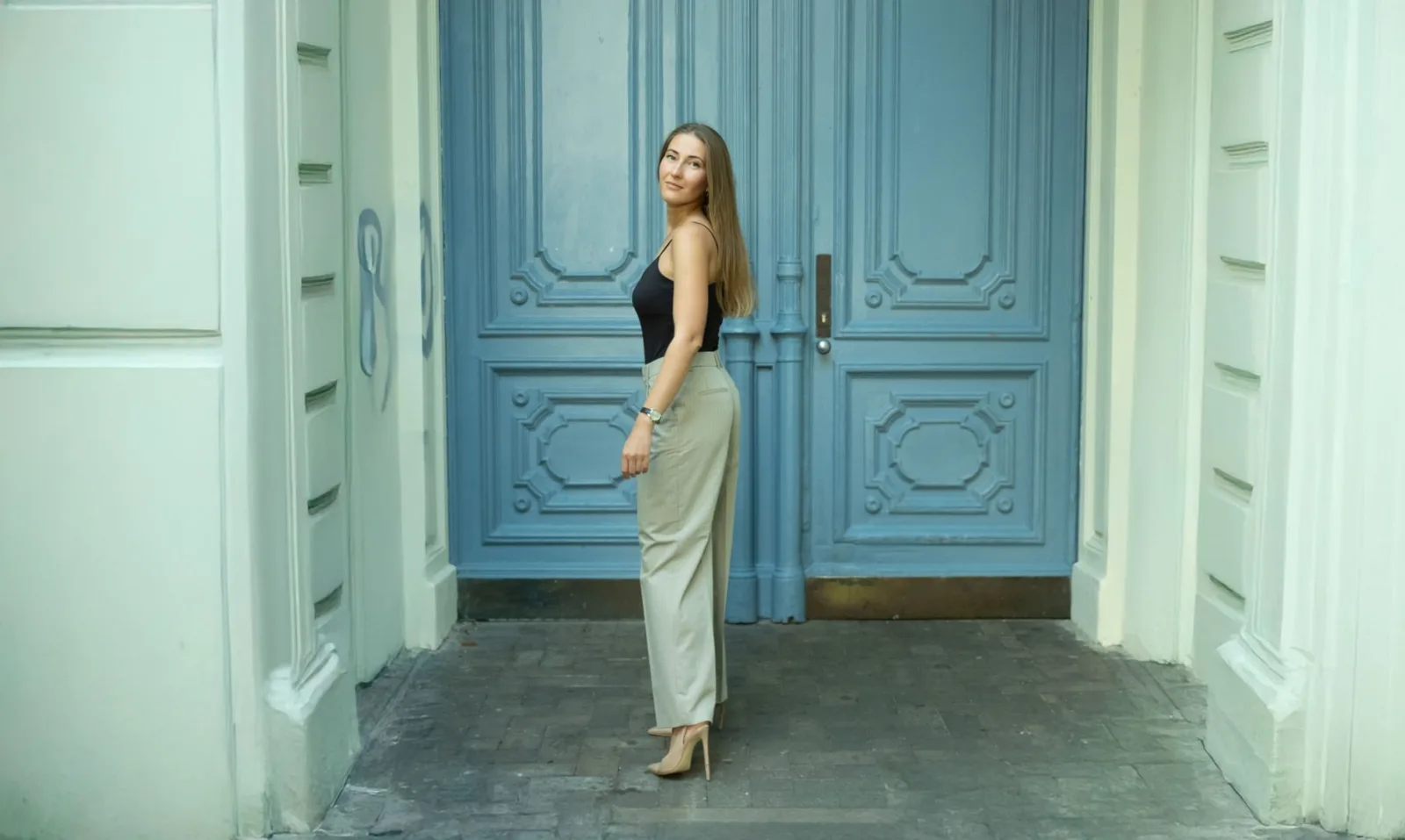
In short:
- Wide trousers are the family, wide leg and palazzo are two cuts within it: wide-leg trousers have a hem of about 24 to 31 cm flat in a French size 38, palazzo pants often go beyond 38 cm.
- Wide-leg trousers hold their shape (wool, crepe, 12 to 14 oz denim), palazzo pants move (viscose, silk, linen, fluid crepe).
- Palazzo pants are worn about 1 cm above the floor, wide-leg trousers cover the heel of the shoe.
- No sizing standard sets these widths: only the flat measurement on the product page settles it.
Wide trousers cover any leg fuller than a straight cut. Wide-leg trousers and palazzo pants are two specific cuts within that family: the first starts from a fitted waist and falls straight, in a fabric with body; the second flares from the hip, in a fluid fabric, with a fullness that recalls a long skirt. Baggy trousers, often mixed up with both, are something else again. The surest way to tell them apart is to read their measurements, centimetre by centimetre.
Wide trousers, wide leg, palazzo and baggy: the measurements in one table
The values below are orders of magnitude for women’s trousers in a French size 38 (UK 10, US 6), measured flat (double the width to get the circumference). They change from one brand and one style to another: use them to read a product page, not as a rule.
| Cut | Waist (rise) | Thigh, flat | Hem, flat | Drape | Common fabrics | Length |
|---|---|---|---|---|---|---|
| Straight (reference) | mid to high, 24 to 30 cm | 27 to 30 cm | 18 to 22 cm | follows the leg | denim, cotton twill, wool | slight break on the shoe |
| Wide trousers (family) | any | 30 cm and more | 23 cm and more | varies | any | depends on the cut |
| Wide leg | high, 27 to 32 cm | 30 to 34 cm | 24 to 31 cm | straight, clean | wool, crepe, 12 to 14 oz denim | covers the heel |
| Palazzo | high to very high, 28 to 33 cm | 35 cm and more | 38 to 50 cm | fluid, skirt effect | viscose, crepe, silk, linen, satin | 1 cm above the floor |
| Baggy | low to mid, 20 to 26 cm | 32 to 36 cm | 21 to 26 cm | full at the top, straight below | heavy denim, cotton canvas | breaks on the shoe |
One detail stands out: the hem of a baggy pair can be narrower than that of a wide-leg pair. Everything happens at the top of the garment.
Wide trousers: a family rather than a cut
“Wide trousers” is not the name of a cut. It is the generic label online shops put on any style whose leg is clearly fuller than a straight pair, which in practice means a hem wider than 22 to 23 cm flat in a French size 38. Wide-leg trousers, loose-fit trousers, palazzo pants, culottes and some baggy styles all belong to it.
No standard settles the question. The international standard ISO 8559-1, published in 2017, defines how to measure the body (waist girth, hip girth, inside leg length) to designate clothing sizes. It says nothing about the width of a trouser leg: that measurement belongs to the garment, and each brand sets it freely. Hence product pages that call a simply wide pair palazzo, or a pair of jeans barely fuller than a straight cut wide leg.
Our advice: ignore the name and read three numbers, the rise, the thigh and the hem.
Wide-leg trousers: a straight, wide leg inherited from tailoring
Wide-leg trousers come from tailored trousers. They keep a fitted waistband and structured hips, then a leg that falls straight and wide to the floor, without flaring further below the knee, unlike flare jeans. That vertical line is what sets them apart from flares or bell-bottoms, which widen from the knee down.
In a French size 38, the hem width is around 24 to 31 cm flat, which is a leg circumference of about 48 to 62 cm. Wide-leg jeans tend to sit at the lower end of that range, tailored trousers at the upper end.
Fabrics and drape of wide-leg trousers
Wide-leg trousers hold their shape because they are cut from fabrics with body:
- wool and wool blends, flannel, for a dressy version;
- heavy crepe, which falls straight without clinging;
- 12 to 14 oz denim, about 400 to 475 g/m², for wide-leg jeans that keep their line;
- cotton twill or heavy linen canvas, for summer.
A pressed crease down the front of the leg stresses the vertical line. In a fabric that is too soft, wide-leg trousers lose their crispness and start to look like palazzo pants.
Palazzo pants: fullness from the hip
Palazzo pants are the fullest version of the family. The leg opens from the hip and stays very wide down to the floor, with a hem often wider than 38 cm flat in a French size 38 and close to 50 cm on the fullest styles. In motion, the effect recalls a long skirt.
The waist is almost always high, even very high (28 to 33 cm of rise), often elasticated or belted. The fabrics match that choice: viscose, fluid crepe, silk, satin, washed linen, heavy jersey. The lighter the fabric, the more the leg follows the body as it moves. A thick wool, on the other hand, adds volume over the hips.
Where the name palazzo comes from
The name comes from the “palazzo pyjamas” presented in 1960 by the couturier Irene Galitzine, based in Rome: wide evening trousers in soft silk. The name stuck for any very full, fluid trousers, worn day or night.
Baggy trousers: the fullness sits at the top of the leg
Baggy trousers are often confused with wide-leg trousers, yet their logic is the reverse. They give room at the hips and thighs (32 to 36 cm of thigh width flat in a French size 38), sit low on the hips with a rise of 20 to 26 cm, then fall straighter towards the hem. The leg can even narrow slightly at the bottom.
On a product page, baggy trousers show in the thigh width and the rise, not in the hem. Search results treat them separately too: someone looking for baggy jeans is not looking for palazzo pants.
How to read the measurements on a product page
Size guides give body measurements. Garment measurement charts, when the brand publishes them, give the measurements of the trousers. Those are the ones that identify a cut. Here is what they mean:
- The rise: from the crotch seam to the top of the waistband, at the front. Above about 27 cm in a French size 38, the waist is high.
- The thigh width: measured flat, a few centimetres below the crotch.
- The hem width: measured flat, from one edge of the leg opening to the other. Double it to get the circumference.
- The inside leg: from the crotch to the hem, around 78 to 82 cm on full-length trousers.
To compare with your own body, measure a pair you like, laid flat on a table, with a tape measure. The same care applies to size: if you order from a French, British or American site, our women’s size conversion chart for France, the UK and the US keeps you from reading the wrong column.
Which cut for which body shape
Body shape changes little to the basic rule: a wide leg lengthens the figure when it falls from waist to floor in one line. A few pointers help to choose:
- Hips wider than shoulders: palazzo pants, fluid from the hip, do not mark the pelvis. Pick a light fabric rather than a wool.
- Shoulders wider than hips: wide-leg trousers in a fabric with body rebalance the figure, because they add volume at the bottom.
- Straight figure: both cuts work; a marked belt draws the waist.
- Petite: a high waist is a must, with a hem that covers the heel. Skip mid-calf cropped versions, which cut the leg.
- Tall: check the inside leg first, palazzo pants that are too short lose all their effect.
A frank remark: deep pleats at the waist add volume over the stomach. On palazzo pants that are already full, a flat or elasticated waist falls more cleanly.
Which shoes and which hem length
Length is always set with the shoes you will wear. Wide trousers that are too short look shrunk; trousers that are too long wear out against the floor.
| Cut | Hem length | Shoes that work |
|---|---|---|
| Full-length wide leg | covers the heel, 1 to 2 cm above the floor | court shoes, ankle boots, loafers, low trainers |
| Cropped wide leg | at the ankle | mules, ballet flats, open court shoes |
| Palazzo | about 1 cm above the floor | heels, wedges, platform soles, sandals |
| Baggy | breaks on the shoe | chunky trainers, ankle boots |
A useful detail for palazzo pants: they are hemmed for a given heel height. If you switch between 7 cm heels and flat sandals, the same pair cannot fall right with both. Choose your reference pair of shoes before having the hem taken up.
What top to wear with wide trousers
A wide leg calls for a top closer to the body, or tucked into the waistband, to keep the waist visible. With fluid palazzo pants, a vest top, a bodysuit or a fine knit tucked in balances the fullness. With wool wide-leg trousers, a tucked-in shirt or a cropped jumper works well.
In winter, fine knitwear takes over. The best wool and cashmere sweater brands for women offer short or fitted styles that tuck in without bunching at the waist. If you are unsure about the fibre, our article on cashmere vs merino sets out what changes in warmth, fineness and care. A long, chunky jumper over palazzo pants, on the other hand, hides the waist and shortens the figure.