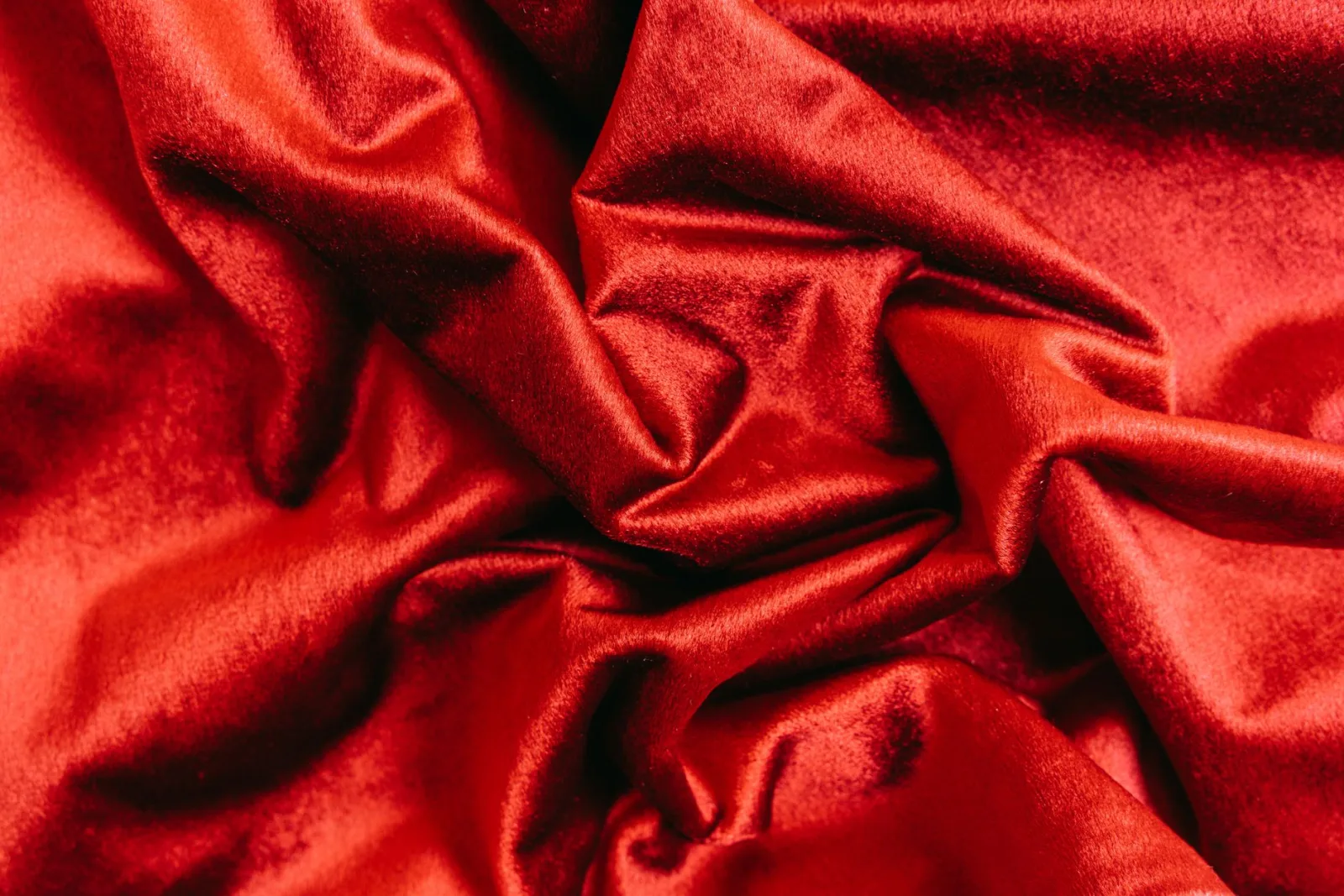
In short:
- Velvet is a way of weaving, not a fibre: its cut pile comes from an extra warp (plain velvet) or from the weft (corduroy), in silk, viscose, cotton or polyester.
- Corduroy is counted in wales per inch (2.54 cm): from 1.5 to 21, 10 to 12 for standard corduroy, more than 16 for needlecord, a little over 6 wales per centimetre.
- A fluid velvet (silk, viscose, panne, devoré) suits fits that move, bias-cut slip and wrap dresses; a velvet with body (cotton, corduroy) holds a straight, pinafore or trapeze dress.
- Regular viscose is best dry cleaned, and an iron with one dot on the label means 110 °C at most: on the pile, use steam from a distance.
For a velvet dress, choose the velvet first and the fit second: the weight and suppleness of the fabric decide what the dress can do. Silk or viscose velvet falls almost like a liquid and calls for a bias cut, a slip dress or a wrap dress. Cotton velvet or corduroy nearly stands up on its own: it shapes a straight dress, a pinafore or a trapeze line. Then comes the length, mini, knee or midi, set by the occasion and by your shoes.
Dress velvets and the fits that suit them: the table
| Velvet | What defines it | Common fibres | Drape | Dress fits that suit it |
|---|---|---|---|---|
| Plain velvet | short, dense pile from an extra warp that is cut | silk, viscose, cotton, polyester | depends on the fibre | all, depending on the fibre |
| Corduroy | pile from the weft, in vertical wales; 1.5 to 21 wales per inch, 10 to 12 as standard | cotton, cotton and wool | holds its shape | straight, pinafore, shirt dress, trapeze |
| Needlecord | corduroy with very fine wales, more than 16 per inch | cotton | holds its shape, softer | shirt dress, straight dress |
| Devoré velvet | pattern made by dissolving the cellulose fibre in a blend | silk and viscose | fluid, sheer in places | slip dress, long evening dress |
| Crushed velvet | pile pressed in several directions, or fabric twisted while wet: uneven sheen | depends on the fabric | fluid | slip, wrap, soft trapeze |
| Panne velvet | pile forced flat in one direction under heavy pressure | depends on the fabric | fluid | slip dress, long dress |
| Silk velvet | silk pile, often blended with viscose or cotton | silk, silk and viscose | very fluid | bias cut, slip, wrap |
| Viscose velvet | viscose pile, softer than cotton | viscose | fluid | wrap, slip, flared midi |
| Cotton velvet | cotton pile, more matte than silk | cotton | holds its shape | straight, trapeze, pinafore |
| Stretch velvet | velvet with a little elastane added | polyester or viscose and elastane | close to the body | fitted straight, sheath, bustier |
Definitions and figures: encyclopedia entries Velvet, Corduroy, Devoré and Rayon. Drape and fits: reading guides, to confirm against the composition on the product page.
Velvet is a weave before it is a fabric
On clothing as on curtains, velvet is recognised by its pile: cut, dense threads standing up on one side of the fabric. To make it, the loom weaves two layers at once, joined by an extra warp that runs over rods; the two layers are then separated by cutting those threads, and each keeps its pile (encyclopedia entry on velvet). The French entry Velours accordingly separates warp velvet, or cut velvet, whose pile comes from the warp, and weft velvet, which gives corduroy. The word goes back to the Latin villosus, “hairy”.
The technique is old. Velvet was introduced to Baghdad under the caliph Harun al-Rashid (786 to 809). In the 19th century, double velvet, woven on Jacquard looms from the 1830s, produced two pieces at once and cut its cost in half.
Plain velvet or corduroy: two piles, two looks
Plain velvet has a short pile spread over the whole surface. It reflects light differently depending on the direction of the pile: cut pile up or pile down, it looks shinier or deeper in colour. On a dress, every panel must therefore be cut in the same direction, otherwise the front and back look like two shades. Dark tones, black or burgundy, make the most of this effect.
Corduroy reads differently. Its pile, formed by the weft, makes vertical ridges called wales, separated by a channel. They are counted per inch, 2.54 cm, and that is the figure to look for on a product page (encyclopedia entry on corduroy):
| Common name | Wales per inch | Wales per cm | Uses cited |
|---|---|---|---|
| Wide wale | from 1.5 | from 0.6 | trousers, sofas |
| Standard corduroy | 10 to 12 (11 most often) | 3.9 to 4.7 | all kinds of garments |
| Needlecord, pinwale | more than 16 | more than 6.3 | tops, shirts, dresses |
| Finest wales | up to 21 | up to 8.3 | tops, shirts, dresses |
Wales per inch: encyclopedia entries Corduroy and Velours côtelé. Wales per cm: rounded conversion (1 inch = 2.54 cm).
The lower the number, the thicker the wales. Encyclopedias keep wide wale for trousers and upholstery, and medium to fine wales for garments worn above the waist. For a dress, which covers the bust, needlecord or standard corduroy are the usual choices. The common story behind the word corduroy, “cord of the king”, is doubtful: its origin is unknown.
Devoré, crushed, panne: velvets with an effect
Devoré velvet starts from a blend of two fibre families, most often silk and viscose. It is printed with a gel containing sodium hydrogen sulphate, which dissolves the cellulose fibre (viscose, cotton) and spares the protein fibre (silk): the pile disappears in places and draws a pattern on an almost sheer base (entry on devoré). The commercial process was developed in Lyon around the turn of the 19th and 20th centuries, then took hold in the 1920s on evening gowns and shawls. A devoré velvet dress is lined, or worn over a slip.
Crushed velvet has its pile pressed in several directions, or the fabric twisted while still wet. Its uneven sheen has a practical upside: marks from sitting or folding barely show. Embossed velvet, for its part, gets its pattern from a heated metal roller.
Panne velvet is a crushed velvet whose pile is forced flat in one direction under heavy pressure. That flattened pile gives it a very lustrous look.
Silk, viscose or cotton velvet: the fibre sets the drape
With the same cut, two velvet dresses can drape in opposite ways. The fibre makes the difference.
- Silk velvet: the most expensive fibre. Velvet made entirely of silk is rare; much of what is sold as “silk velvet” is blended with viscose or cotton. The label says so.
- Viscose velvet: softer and richer than cotton, close to silk to the touch. Viscose is regenerated cellulose, mostly from wood pulp; our guide to viscose fabric covers how it is made and how it behaves in the wash.
- Cotton velvet: hard-wearing, more matte, with a shorter pile. It is the velvet of day dresses and of most corduroy.
- Polyester and microfibre: a light velvet that resists stains. Nylon and viscose blends feel close to silk, at a more affordable price.
- Stretch velvet: velvet with a small percentage of elastane, for fitted dresses that stay comfortable when you sit down.
Which dress fit for which velvet
The wrap dress
A wrap dress closes by crossing one side over the other, fastened at the side or tied at the back, which forms a V-neck (entry on the wrap dress). Its best-known version, long-sleeved and knee-length, took off in the 1970s, in jersey. In velvet, it needs a thin, supple fabric, viscose or silk, because the wrap doubles the thickness at the waist. Crushed velvet works well: it hides the creases of the knot.
The straight dress
A straight dress falls from the shoulders to the hem without marking the waist. It needs a velvet that holds its shape: cotton velvet, corduroy, needlecord for a buttoned shirt dress. In stretch velvet, the same line becomes a fitted sheath that follows the silhouette. A pinafore dress, sleeveless, is worn over a top; under corduroy, a fine-knit turtleneck sweater carries the dress up to the neck and keeps the line clean.
The slip dress
A slip dress borrows the shape of a petticoat: thin straps and a bias cut, diagonal to the straight grain, so the fabric follows the body (entry on the slip dress). It spread in the 1990s, with the underwear-as-outerwear trend, in chiffon and satin. In velvet, it needs a fluid pile: silk, viscose, panne or devoré. Corduroy, too stiff for the bias, turns it into a pinafore.
The trapeze dress
A trapeze dress is fitted at the shoulders and then flares to the hem. The Trapeze line shown by Yves Saint Laurent in spring 1958 gave this A-shaped silhouette its clearest form (entry on the A-line). In velvet, the trapeze needs body to keep its flare: cotton velvet or corduroy. In a fluid velvet, the fullness drops and the dress becomes a softer flared dress.
Mini, knee or midi: the length
Length names are read off the leg: above the knee, at the knee, below the knee, at mid-calf (the midi dress), at the ankle, at the floor (entry on hemlines). They moved fast in the 20th century: almost to the floor in 1919, mid-calf in 1920, back to the ankles in 1923, at the knee in 1927.
A product page gives the length in centimetres for a single size, its reference size. To know where the hem will fall on you, measure with a tape from the top of the shoulder down to the point you want, and compare with the total length shown. If you order from a French or European site, our women’s size conversion chart keeps you from reading the wrong column.
| Fit | Velvets that suit it | Usual lengths | Occasions |
|---|---|---|---|
| Wrap | viscose, silk, crushed | knee, midi | office, dinner, winter wedding |
| Straight | cotton, corduroy, needlecord, stretch | mini, knee | office, daytime |
| Pinafore | corduroy, cotton | mini, knee | daytime, over a turtleneck |
| Slip | silk, viscose, panne, devoré | midi, long | evening, holidays |
| Trapeze | cotton, corduroy | mini, knee | daytime, going out |
Choice guides. Fit definitions: encyclopedia entries cited in the sections above.
Occasions: from the office to the holiday season
At the office, a needlecord shirt dress or a dark viscose midi wrap dress goes with ankle boots or pumps. Over a straight dress, a structured jacket adds a shoulder line: our guide to women’s blazer fits covers the lengths that sit right over a dress.
For an evening or the end-of-year holidays, plain silk or viscose velvet takes over again, as a slip dress, a long dress or devoré. An asymmetric, slit or draped dress makes the most of a fluid drape; a bustier dress needs a stretch velvet that stays put.
In winter, the length of the dress dictates that of the coat: a midi dress showing below a short coat cuts the silhouette in two. Before ordering, check the coat length as closely as its shoulder width, as our article on women’s coat size explains.
Our view: for a first velvet dress, a midi wrap dress in black or burgundy viscose velvet covers the most occasions, from the office to New Year’s Eve.
Caring for a velvet dress
Velvet is hard to clean because of its pile; modern dry cleaning has made it much easier. The starting rule is still the label, whose symbols follow the international standard ISO 3758, developed with the European association GINETEX (entry on laundry symbols).
- Read the composition and the symbols. A circle with a P or an F means professional dry cleaning, a W professional wet cleaning. Under the washtub, one bar means medium agitation, two bars very gentle agitation.
- Viscose velvet: regular viscose is best dry cleaned, as it copes poorly with water (entry on rayon).
- Corduroy or cotton velvet: if the label allows the machine, wash the dress inside out, cold or at 30 °C, gentle spin, no tumble dryer.
- Dry it in the air, on a wide hanger, smoothing the pile in its direction with your hand.
- Remove creases without crushing the pile. An iron with one dot means 110 °C at most, two dots 150 °C. Never put the soleplate on the right side: a garment steamer held a few centimetres away lifts the pile, or press lightly on the reverse.
- Store the dress hanging, with space around it: velvet squeezed into a wardrobe keeps the marks of the hangers next to it.
One last check, when you buy: lay your hand flat on the fabric and slide it both ways. If the shade changes under your fingers, every part of the dress must have been cut in the same direction.