In short:
- Boiled wool is a wool knit agitated in hot soapy water: it felts and comes out as much as 50% smaller in every direction.
- It keeps you warm because it is dense: it holds still air and slows the wind, which can take 10 to 60% of an outfit’s thermal resistance between 1 and 8 m/s.
- Felting locks the fibres together: a cut edge does not fray, which is why boiled wool jackets can have raw, unhemmed edges.
- Felt starts as loose fibres, broadcloth and loden as woven cloth: only boiled wool starts as a knit.
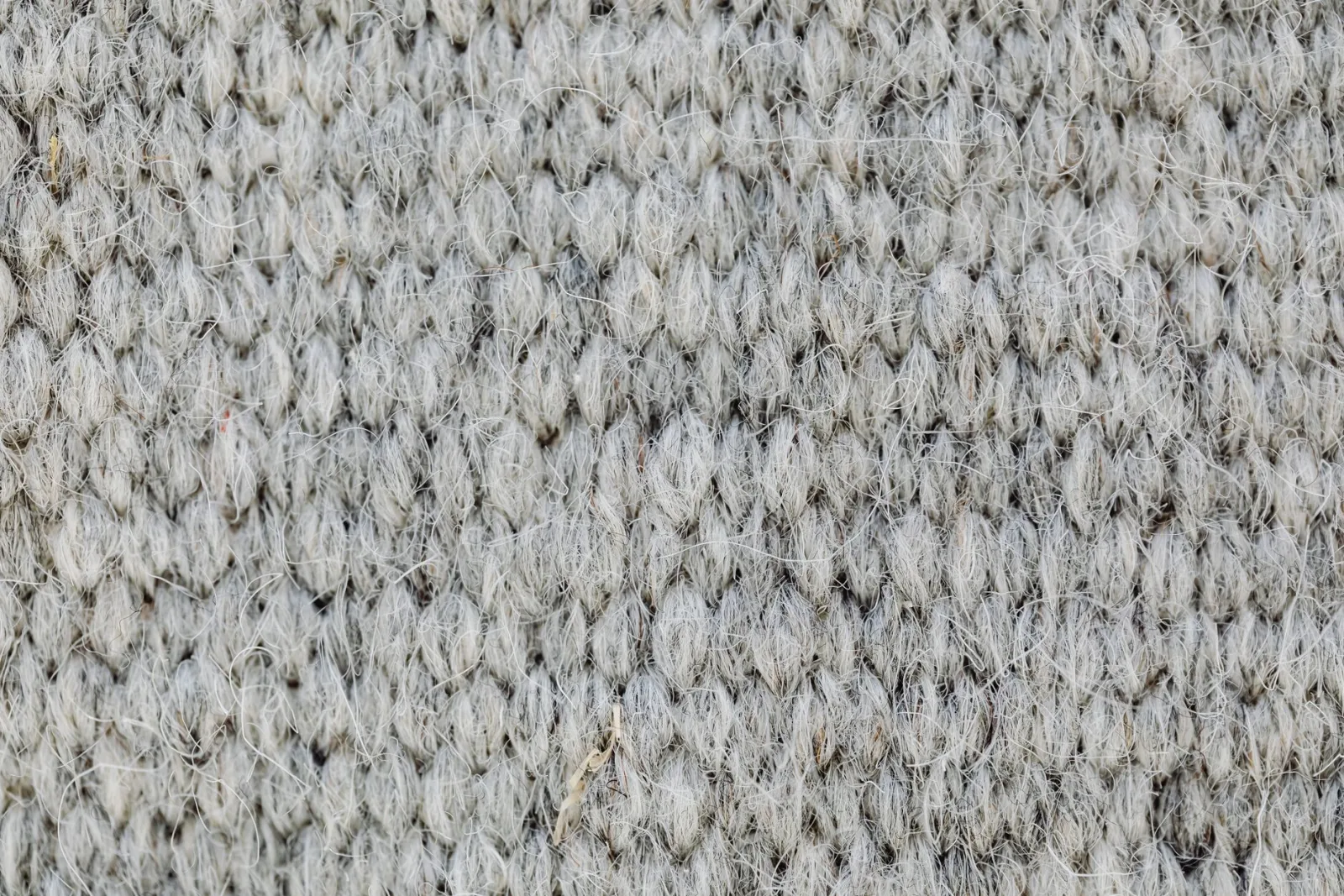
Boiled wool is a wool knit that has been shrunk on purpose. The knitted fabric is agitated in hot water with an alkaline solution, usually soap, its fibres catch on one another and the whole thing tightens into a dense, felt-like cloth. The process has a name: fulling. It accounts for the three qualities boiled wool is known for. It holds warmth. It stops the wind. And you can cut it with scissors without the edge unravelling.
Boiled wool, felt, loden, broadcloth: the comparison table
| Fabric | Before fulling | Process | Result | Distinctive trait |
|---|---|---|---|---|
| Boiled wool | wool or wool-blend knit | hot water, soap, agitation | dense cloth, up to 50% smaller in every direction | does not fray, resists further shrinkage |
| Wool felt | loose fibres, neither spun nor woven | hot water, agitation and compression, or needle felting | compact nonwoven | no yarn, so no stitch to run |
| Loden | loosely woven strong yarns, mountain sheep wool | long shrinking, then teasel brushing and nap clipping, repeated | dense, felt-like cloth | warm for its weight, windproof, very hard-wearing |
| Broadcloth | plain-woven cloth, woven 50 to 75% wider than its finished width | milling in hot soapy water | smooth face where the weave no longer shows | takes a cut edge without hemming |
Sources: encyclopedia entries Boiled wool, Felt, Loden cape and Broadcloth, Wikipedia, consulted on 20 October 2026.
How is boiled wool made?
It all starts with a knit of even thickness, in pure wool or a blend. It may be dyed first or left natural. Then comes fulling: the knit is agitated in hot water with an alkaline solution. As it moves, the scales that cover the surface of each fibre catch on each other and the knit felts. At the end, the fabric can be up to 50% smaller in every direction than before, according to the encyclopedia entry on boiled wool.
The mechanism comes down to the shape of the wool fibre. Its scales slide more easily in one direction than the other: with water, heat and friction, the fibres creep forward, lock and end up forming a tight network. A 2019 review of anti-felting treatments describes this behaviour, the very one industry tries to neutralise to make wool machine-washable (Journal of Advanced Research, 2019). Boiled wool does the opposite: it takes felting all the way.
Up to 50% shrinkage, but not for every knit
The 50% figure is a ceiling, not a rule. A Textile Research Journal study of plain wool knits showed that felting shrinkage depends first on the cover factor (how tight the knit is) and the loop length, then on fibre diameter and yarn twist (Textile Research Journal, 2004). Earlier work on 54 combinations of knits pointed the same way: a tight knit and a fine yarn felt more slowly (Textile Research Journal, 1968).
What matters to you: the shrinking happens at the mill, before the garment is cut. A boiled wool jacket has already been through its big shrink, and the dense cloth that comes out resists further felting better. Better, not fully: a hot, agitated wash can still tighten it.
A process that goes back to Antiquity
Fulling is one of the oldest textile operations. In Pompeii, when Vesuvius erupted in 79 AD, 39 wool workshops were running, 11 of them fullonicae, the fullers’ workshops, according to the French encyclopedia entry on fulling. Cloth was trampled there in tubs of water and urine. In the Middle Ages, fuller’s earth, a clay that absorbs grease, took over, and water mills drove wooden hammers: the earliest known French reference dates from 1086, in Normandy (Fulling). Austrian loden, produced since the 16th century, and Flemish duffel, first made in the 14th century, come from this tradition. Boiled wool itself remains linked to the traditional textiles of Tyrol and South America.
Why does boiled wool keep you warm?
Clothing insulates mainly through the still air it holds. Fibres conduct heat 5 to 20 times better than air, so it is the air trapped between them and inside the knit that slows heat loss (Materials, 2023). Wool is good at this: its fibres hold air within the fabric (Wool).
Density against the wind
Wind drives that air out. Measurements by VTT, the Technical Research Centre of Finland, showed that raising wind speed from 1 to 8 m/s cut the total thermal resistance of clothing measured on a cylinder by 10 to 60% when dry, and by 5 to 40% when wet (VTT, 1993). A chunky, open-knit sweater lets air through its stitches. Boiled wool, tightened by fulling, resists wind and water: that is its real strength in a coat or a jacket.
Moisture as a source of heat
Wool can absorb almost a third of its own weight in water (Wool). As it takes up moisture, it even gives off heat. A study published in 2026 measured this heat of wetting on clothing fabrics: merino wool fabrics released the most, ahead of viscose and cotton, while polyester produced almost none (Fibers, 2026).
Warmth without bulk?
Partly. At equal weight, a dense, windproof cloth insulates better outdoors than an airy knit, and loden, its woven cousin, is described as warm for its weight. But thickness is still the first driver of insulation when you stand still. A thin boiled wool spring jacket will not replace a lined winter coat. A rule of thumb: for city wear from October to March, a decent-weight boiled wool layer over a fine sweater beats a chunky knit worn alone, precisely because it blocks the wind.
Why boiled wool does not fray
Cut an ordinary knit and the loops come undone, row after row: the knit runs. Cut a woven cloth and the edge yarns slip out: it frays. In boiled wool, felting has tangled the fibres from one loop to the next. There is no free loop left to undo, and the dense fabric resists fraying (Boiled wool).
You can see this on the garment. Raw edges, cut clean, are the signature of boiled wool: jacket lapels without facing, sleeves without hems, patch pockets cut in a single stroke. For sewing, it is also a fabric you can work without finishing the seam allowances. Broadcloth shares this quality: its encyclopedia entry notes that it takes a cut edge without needing a hem (Broadcloth).
Boiled wool, fulled wool, felt, loden: what sets them apart
Shops often mix up the names. The deciding factor is the starting fabric.
Felt: loose fibres
Felt is a nonwoven: loose fibres are pressed and agitated in hot water, or tangled with barbed needles. There is no yarn and no stitch. It is one of the oldest known textiles: felt hats found in the Inner Mongolia region of China date to around 1800 BCE (Felt). Plant and synthetic fibres do not wet-felt: an acrylic felt is made with needles.
Fulled wool and broadcloth: woven cloth
Fulled wool or broadcloth usually means a woven cloth, warp and weft, that has been fulled. Traditional woollen broadcloth, which originated in Flanders, was woven 50 to 75% wider than its finished width, then milled in hot soapy water until the weave vanished under a smooth face (Broadcloth). Its drape is stiff, according to the same entry.
Loden: the Tyrolean version
Loden is a thick, water-resistant wool cloth, associated with Tyrol and traditional Austrian dress. It is loosely woven from strong yarns of mountain sheep wool, shrunk over a long process, then brushed with a teasel and clipped, several times over (Loden cape). Its entry describes it as warm for its weight, windproof and extremely durable. It is often confused with boiled wool, wrongly: its base is woven, not knitted.
What the label says
“Boiled wool” names a process, not a fibre. The composition label follows Regulation (EU) No 1007/2011, which keeps the word “wool” for sheep’s fleece. So read the percentages: a “100% wool” jacket and one made of 70% wool and 30% polyamide will not react the same way to fulling or to wear.
Caring for boiled wool: washing, drying, pilling
Felting never stops completely. Hot water, agitation and temperature shocks are the three enemies of boiled wool, as of any untreated wool.
- Read the care label: its symbols follow the ISO 3758:2023 standard.
- Air it rather than wash it. A jacket worn over a sweater can hang outside overnight and be brushed with a clothes brush.
- If you do wash it, do it by hand, in cold or lukewarm water, with a wool detergent, without rubbing or wringing.
- Rinse at the same temperature as the wash. A sudden change on wet wool speeds up felting.
- Press the garment in a towel, then dry it flat, away from a radiator. Never tumble dry unless the label says so.
- To remove creases, use steam from a distance or a cool iron with a pressing cloth, a damp cloth placed between the iron and the wool.
As for pilling, boiled wool is not immune. Pills form when short fibres migrate to the surface and roll up under friction; a study on cashmere knits links pilling mainly to fibre length (Li and Zhou, 2006). Keep an eye on the forearms, the sides of the body and the lower back, rubbed by a bag or a seat back. A sweater comb held flat does the job, without pulling the pills.
Which boiled wool garment to choose
Boiled wool is found mostly in coats, jackets, vests, cardigans, berets and scarves. Three pointers to choose well:
- The coat: a thick boiled wool takes up room, especially over a sweater. Compare the coat’s chest measurement with yours using our guide to women’s coat size, and allow ease for the layer you will wear underneath.
- The jacket: boiled wool suits unlined jackets with raw edges. For length and fit, our guide to women’s blazer fits covers shoulders, waist and length for your figure.
- The cardigan or sweater: if your skin reacts to wool, fibre diameter matters more than the process. Our cashmere vs merino comparison gives the values in microns, and our selection of the best wool and cashmere sweater brands for women lists the compositions each brand publishes.
One last reflex in the shop: fold the edge of a boiled wool garment between two fingers. If the cut edge stays clean and you can barely make out the knit any more, the fulling has been taken far.